• Man at His Best 2025
  • Long Reads
  • Style
  • Money
  • Wheels
  • Culture
  • Opinion
  • CORNER OFFICE
Search
Menu
Close
Close
  • Man at His Best 2025
  • Long Reads
  • Style
  • Money
  • Wheels
  • Culture
  • Opinion
  • Style
    • Fashion
    • Grooming
    • Watches
  • The Good Life
    • Pursuits
    • What She Wants
    • Mavericks
    • The Directory
    • The Noble Man
  • Culture
    • Food & Drink
    • Arts & Entertainment
    • Lifestyle
    • Tech
    • Movies & TV
    • Music
    • Books & Art
    • Design
  • Wheels
    • Cars
    • Motorcycles
    • Drive
  • Money
    • Industry
    • Wealth
    • Capital
    • Movers
  • Long Reads
    • Notes & Essays
    • ESQ&A
    • What I've Learned
    • Fiction
    • Features
  • Life
    • Sports
    • Health & Fitness
    • Women
    • Sex & Relationships
    • Travel
  • Politics
    • Opinion
    • News
  • COUPONS
  • About Us
  • Terms of Use
  • Privacy Policy

NPC Seal of Registration

Esquire has been granted the NPC Seal of Registration in recognition of the successful registration of its DPO and DPS

© 2026 EsquireMag.ph, All Rights Reserved
Long Reads

Men in Drag, Wooden Phalluses, and Cow Manure Pizza: Welcome to the Baliw Baliw Festival

By Max Limpag
May 24, 2023
Post a Comment

A hymn to San Vicente Ferrer crackled inside the chapel in his namesake barangay on Olango Island last Monday (May 22). It was high noon and the morning's fiesta masses had long ended. Several parishioners sat silently on pews facing the altar with their backs to the small clearing in front of the chapel that would soon erupt in wild celebration.

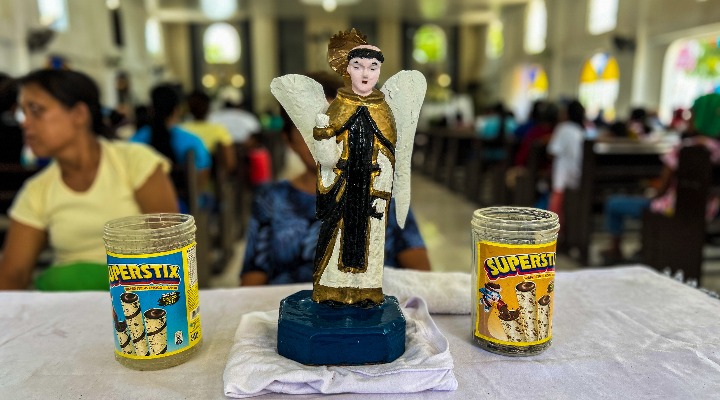
On the chapel entrance was a statuette of San Vicente atop a small table, with two recycled plastic jars that used to contain wafer sticks placed on either side. For donation? I asked a parishioner who nodded and glanced at the still empty containers. The image was facing the small parking lot where people were waiting for the arrival of the bigger version of the saint’s statue, which was then being brought around the island via a procession of small boats called sakayans.

At close to 1 p.m., the crowd began to stir with shouts of “duol na, naa na” (it’s near, it’s here). People took positions on the short alley from the shore to the chapel. Two women who just came out of a house by the roadside argued over where they would stay. They just had fiesta lunch and, in these parts, anyone can just go inside a house and eat. I did, and at the barangay captain’s house no less. The two women kept saying how full they were. The one cradling a baby wanted to get away from the crowd and watch further up the road. Her companion wanted to stay where they were because she wanted to take videos.

“Mag blogger ka?” the woman with the child mocked her companion.

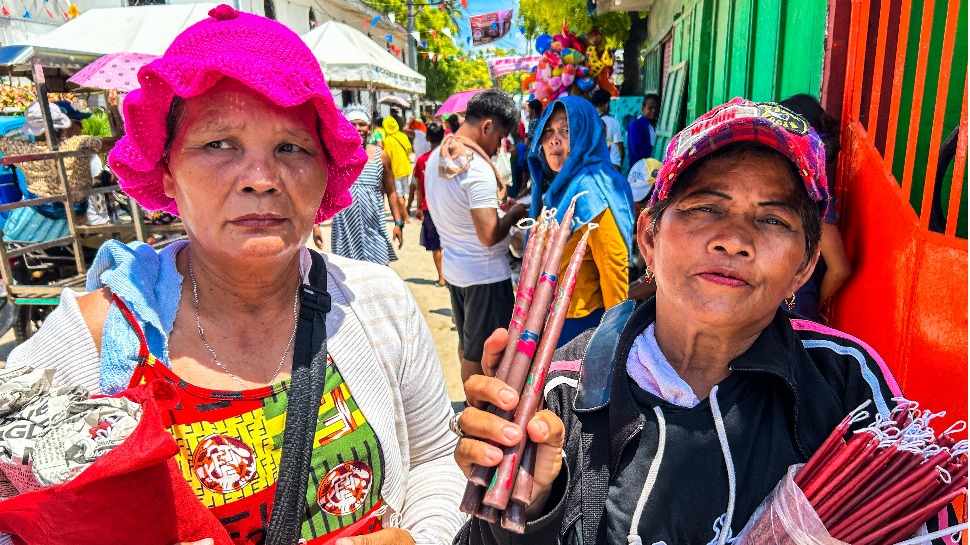
TINDERA SINULOG. Candle vendors Miguela Montanez, 59, and Nenita Regado, 54, sell candles at the Virgen de Regla Parish. They perform what is called the tindera Sinulog - they sell you the candles, ask for your name, and then dance in prayer asking for your good health and the granting of your wishes. The two were in  San Vicente in Olango Island for the Baliw Baliw Festival. The sale of candles wasn't good, they said

A line of volunteers, members of the local chapter of the Guardians Brotherhood, started to herd the crowd, holding them back to make a path from the shore to the chapel. They barred tricycles from passing through, which would cause a line of close to half-a-kilometer of tricycles and habal-habal or motorcycles for hire to form on the narrow barangay road leading to the chapel.

When the boat carrying the image of San Vicente Ferrer came ashore, people started to wave their hands and cheer. After a few minutes, a stream of people headed to the chapel. First to pass were those who were swimming in the shallows to wait for the fluvial procession. Then came a line of children dressed as angels. And then, pandemonium.

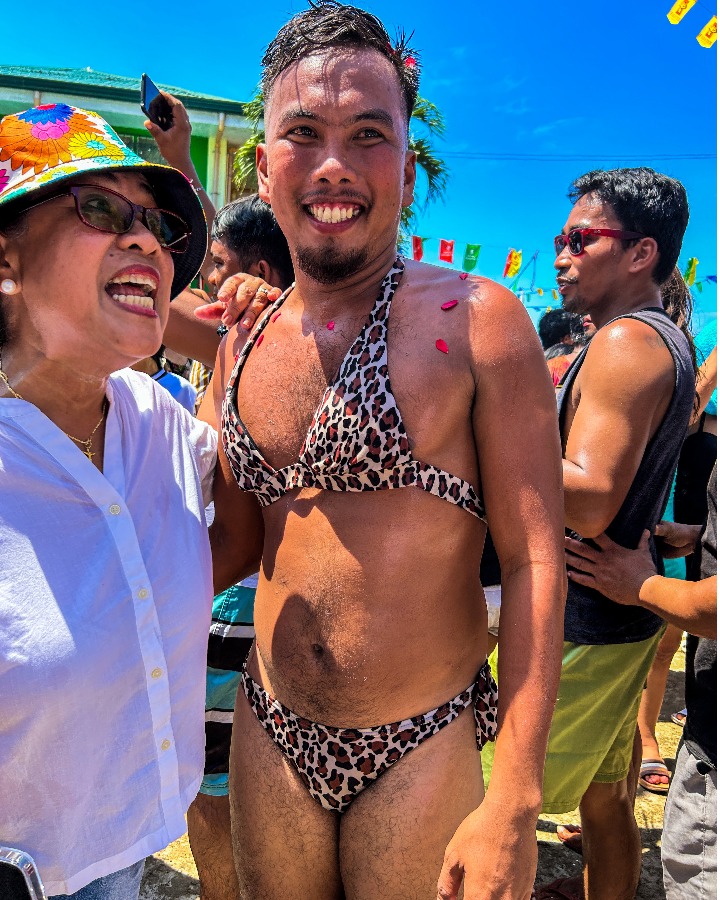
The image of San Vicente Ferrer was on a wooden carriage held up high by young men dressed as women, their faces smeared with makeup and lipstick. Some were already drunk. “Viva Senyor San Vicente!” they screamed as they carried the image to the chapel. Among them was Mark Anthony Jumao-as, a 27-year-old worker at the Disaster Risk Reduction Management Office (DRRMO) of Lapu-Lapu City. The compactly built Jumaos, who was sober, was wearing a bikini.

Mark Anthony Jumao-as is a 27-year-old worker at the Disaster Risk Reduction Management Office (DRRMO) of Lapu-Lapu City. He has been crossdressing for the Baliw Baliw Festival since he was 16. With him is Lapu-Lapu City Councilor Annabeth Cuizon

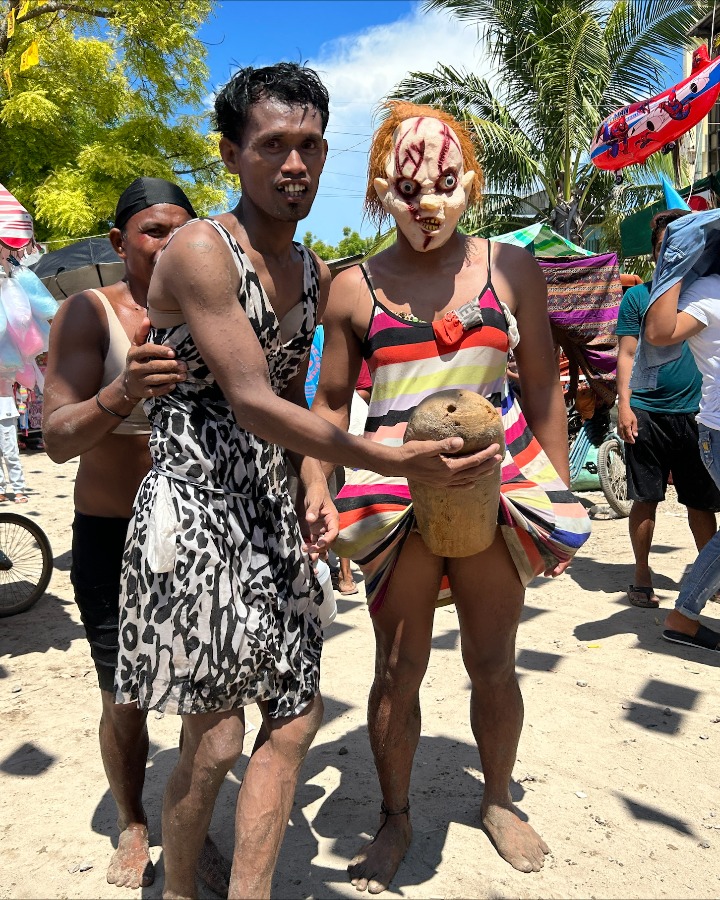
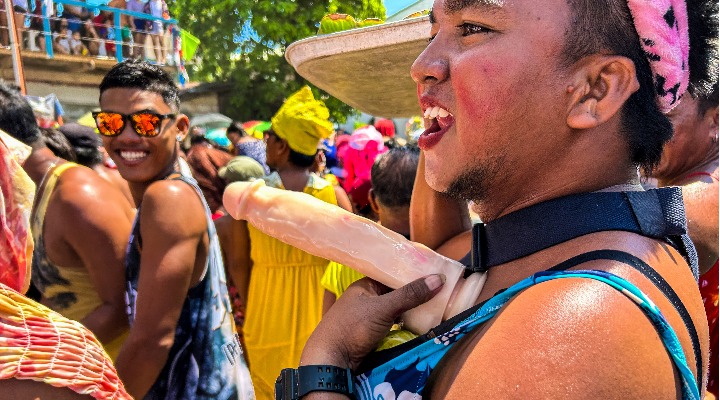
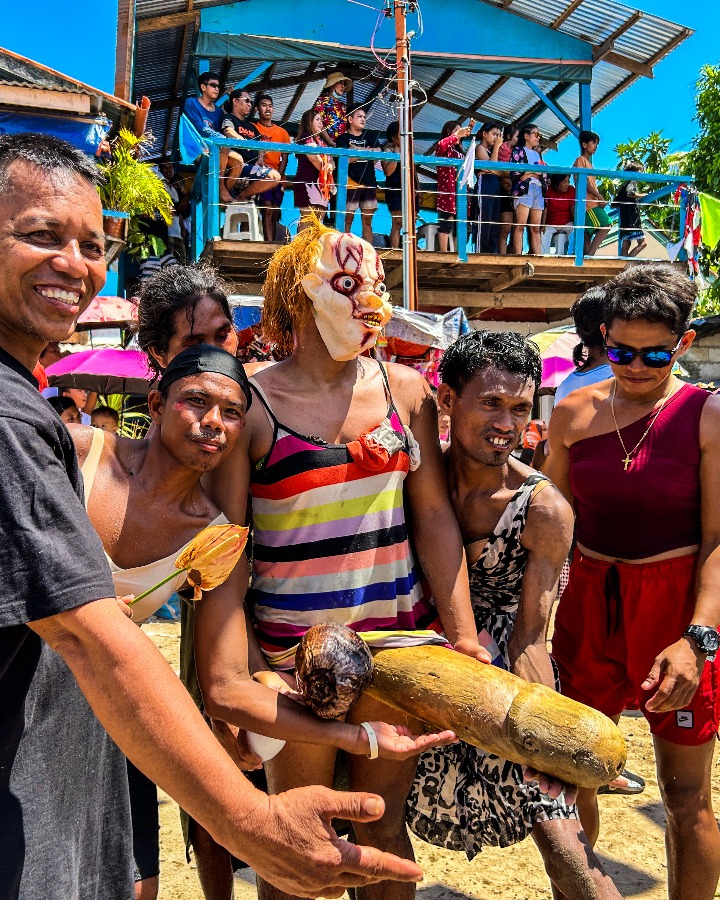
The crowd started shouting at first “Viva!” and then monosyllabic chants, guttural screams, and pagan ululations. It was like the babaylans of old, as demonstrated during the launch early this year of a monograph on the roots of the Sinulog dance, only more primal and chaotic. They converged in front of the chapel, a mosh pit of chanting men dressed in drag cheering and screaming at trays of cow manure and fake penises—a wooden phallus about two feet long with two coconuts as balls worn by a festivalgoer with a horror movie mask and a large silicone dildo, which was carried by another man wearing women’s clothes who had two heads of cabbage for breasts.

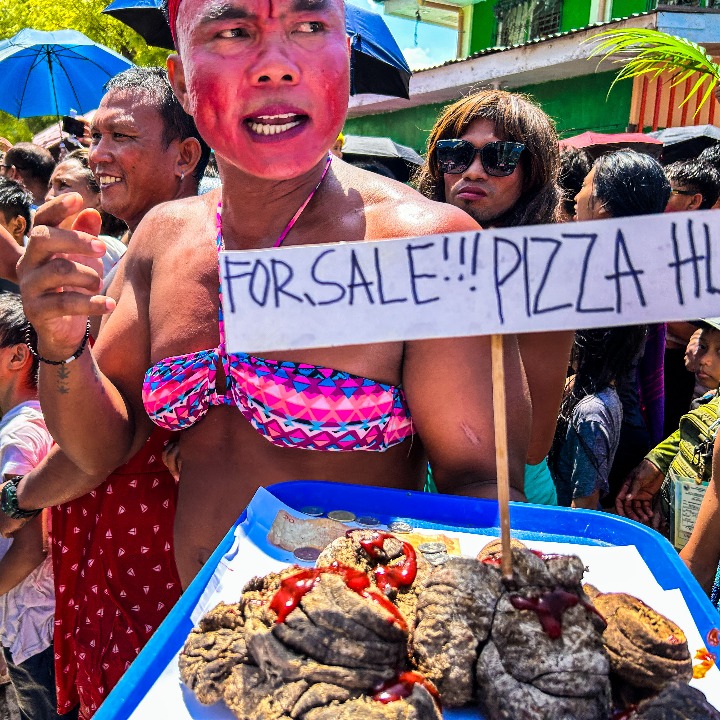
The cow manure they were carrying on trays and offering to people had signs such as “Pizza Hut for sale” and were drizzled with ketchup. They looked to have dried up a little under the scorching sun while people waited for the fluvial procession to finish.

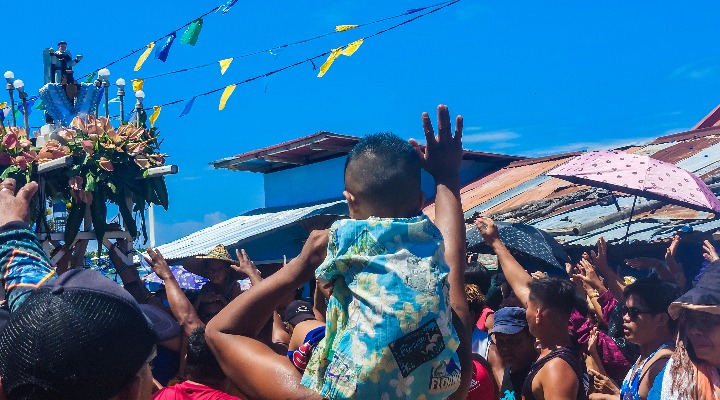
People greet and cheer the image of San Vicente Ferrer after the fluvial procession as it was carried to the chapel

Then they hurled the manure into the air, splattering the crowd that continued to scream and chant. The festival participant who strapped on the wooden phallus kept flashing it to the crowd, with two men helping him hold up the giant penis. I took a video of their group and shouted to ask him what it was for. He approached me and leaned over to my ear—he reeked of liquor—to explain over the chants and loud music that it was for those who were childless that they would be blessed with children by San Vicente Ferrer.

ALSO READ

Cult, Colony or Commune: The Strange Case of the Moncadistas of Cebu

Why Is Cebu City's P8 Billion Carbon Market Redevelopment Project So Controversial?

Baliw-Baliw Festival

The celebration is called the Baliw-Baliw Festival, a curious tradition in Barangay San Vicente on Olango Island, which is a 20-minute boat ride away from Lapu-Lapu City, Cebu. Local residents and the many who visit the barangay for the yearly event don’t know when, why, and how the tradition started. All they could say during interviews is that their grandparents told them it was already happening even while they were still young and to stop it is to invite divine punishment.

It used to be called “sakay-sakay,” local resident Felisa Aying told historian Laila Labajo during a cultural heritage mapping interview in 2021. Aying was already 96 when she was interviewed and she said that it was already happening during the time of her grandfather. Labajo teaches at the University of San Carlos and conducts research on Church history and Cebuano heritage and culture.

Friends help carry a gigantic wooden penis worn by a festival-goer dressed in drag at the Baliw Baliw Festival
article big image
PHOTO: Max Limpag
Post a Comment

The image of San Vicente is placed on a sakayan or small boat for a fluvial procession from the bridge at nearby Sta. Rosa to San Vicente, Labajo said in her field notes. The males would wear women’s clothes, and some would wear big phalluses and dance. It used to be komparza, or a free-flowing dance that combines cha-cha and kuradang, but, later on, speakers would blare Max Surban and Yoyoy Villame songs. On Monday, it was loud rhythmic beats like in a mardi gras parade.

Erwin Eyas, administrator of the San Vicente BoardWalk Marine Sanctuary, said the event should be called “Pabaliw Festival.”

Eyas, who once served as organizer of the event, said “baliw” to mean crazy is a Tagalog word that is not apt for the local tradition. He said “pabaliw” to mean a taboo act that risks divine punishment is the correct Bisaya word to use for the event.

He said it was a “reverse celebration” that mixes paganism and Christianity. He also said some aspects of the festival have been made more shocking and scandalous by outsiders. The purported selling of cow manure as food started with offerings of burnt or leftover rice, Eyas claimed. Having leftover rice signified abundance and offering it to San Vicente Ferrer was to pray for year-round abundance.

In previous years, revelers would play with animals such as using them as fish bait or letting them fight but this was stopped for violating the Animal Welfare Act after photos leaked of the practice.

Eyas said the display of phalluses may have had its roots in devotees who got healed by San Vicente and then stripped naked to prove to the world they were healed.

Labajo, however, said she suspects the play with phallic symbols is related to fertility rituals or linked to fishing.

Some say the Eyas said the display of phalluses may have roots in devotees who got healed by San Vicente and then stripped naked to prove to the world they were healed, although some say she suspects the play with phallic symbols is related to fertility rituals or linked to fishing


Roxanne Omega Doron, executive director of Bisdak Pride, Inc., said Baliw Baliw may have roots in the practice by Spanish colonizers of calling babaylans “baliw.” Doron is currently working on research related to spirituality and sociology of religion.

Doron said the practice in San Vicente can also be traced back to fertility rituals of babaylan, the shamans of old who were often gay men. He said the community’s proximity to Nalusoan Island has significance; luso is Bisaya for penis.

Even the setting of the feast day, Doron said, has roots on the babaylan. The community does not celebrate the fiesta on San Vicente’s traditional feast day in April but on the day in May with the highest noontime tide. This is information that the babaylan has, Doron said, being the link to nature and spirit world.

Through the generations

Land Transportation Franchising and Regulatory Board (LTFRB) Ilocos Region Director Ahmed Cuizon said locals trace the practice to as far back as the 1700s. Cuizon attended the event for the first time on Monday and said he enjoyed it. Cuizon once served as Lapu-Lapu City tourism commissioner and wrote the history of the city as part of the Cebu Provincial Government’s history books project.

A dildo makes an appearance at the Baliw Baliw Festival


Cuizon said the parading of phallic symbols offended a local priest some decades back and he forbade the practice. This led to the fiesta’s decline. He said that it was the late National Artist Ramon Obusan who encouraged the local community to revive the tradition when he went to the barangay in the late 1990s. Eyas said Obusan had long been searching for the place after hearing about the festival. Cuizon said the cultural scholar brought home one of the phallic symbols with the two coconuts as testicles and displayed it in his living room.

Labajo said most priests assigned to the place frown on the practice. It was largely ignored in the homily of popular priest Fr. Ciano Ubod, who presided over one of that morning’s fiesta masses.

“If it is already customary, which means the practice is more than 30 years already, and then it does not go against existing Liturgical law (like within Holy Week), and it was tolerated by the competent authority (the bishop), then it will have the force of law.  But I don't really know its background. I do not know if it is customary to the place,” said canon lawyer Msgr. Raul Go when asked about Baliw Baliw.

The practice, it seemed, has passed on to the next generation. Jumao-as, the DRRMO employee who arranged his schedule to be able to join Baliw Baliw, said he has been part of the tradition since he was 16 years old and that it is now his covenant to those that came before him to continue with the practice. Jumao-as added that was recently visited in his dream by San Vicente to remind him to go to church and to observe his faith.

A Baliw Baliw participant joins the festivities by bringing around a tray of cow manure


Janreb Butalid, 21, joined his friends and also wore women’s clothes during the event. He said it was his offering to San Vicente. Butalid is out of school and without work. He described himself as a tambay during our interview, or Krusty Krab manager on his Facebook profile.

Paquibot cousins Ara, Lahlaine, and Esty were also among the young people who attended Baliw Baliw. Ara took a leave from work. The three said it was a tradition of the place but couldn’t say how it started.

Edwina Sabang, 36, brought her seven-month-old child Jose to the fiesta mass before the Baliw Baliw. She stood outside the chapel, near where the candles were lit for offering. Sabang said she prayed to San Vicente for the child and continues to seek his blessing for their good health. She and a fellow church goer were unenthusiastic when asked about Baliw Baliw but said only to let it be. If it is stopped, like in the past, bad things happen. People get sick, they told me, and some die.

A statuette of San Vicente stands guard at the entrance to the chapel in his namesake barangay on Olango Island. The locals celebrate on the day in May with the highest noontime tide the Baliw Baliw festival in his honor


When the crowd dispersed after the wild dancing and shouting, I asked a group of young men wearing bras and bikinis, “Mao na to?” (Was that it?)

After saying that the Baliw Baliw was done and telling me how to get back to port, they offered a glass of Red Horse beer that they were sharing by the roadside. “Shot sa,” one said with a toothy smile, his lips caked in deep red lipstick. I declined and we fist-bumped as I headed out of the barangay, to return to the mainland.

MORE FROM ESQUIREMAG.PH

Read Next
Is Forensic Science in the Philippines Ready for an AI-Powered Revolution?
Read more stories about
  • Religion,
  • cebu,
  • longreads,
  • Longform,
  • Traditions
Most Shared
by author
Esquire Money
Most Popular
Latest Feed
The New Dean of New York University's Faculty of Arts and Science Is a Filipino
Armscor CEO Martin O. Tuason Passes Away at 51
A Fond Farewell to Chocolate Lover Inc.
The 8-Ball of Greatness in Philippine Pool
Tom Cruise Wore an Extremely Rare £70,000 'President' Rolex Watch to Accept His First Oscar
What Can Poetry Teach Us about Natural Disasters?
#InTheLoop
  • Politics
  • Culture
  • MONEY
  • Style
  • Long Reads
© EsquireMag.ph, All Rights Reserved.
  • About Us
  • Contact Us
  • Terms of Use
  • Privacy Policy
  • Sitemap

We use cookies to ensure you get the best experience on Esquiremag.ph. By continued use, you agree to our privacy policy and accept our use of such cookies. Find out more here.

Present
Read Cover Story
Read Cover Story
Catfish Image